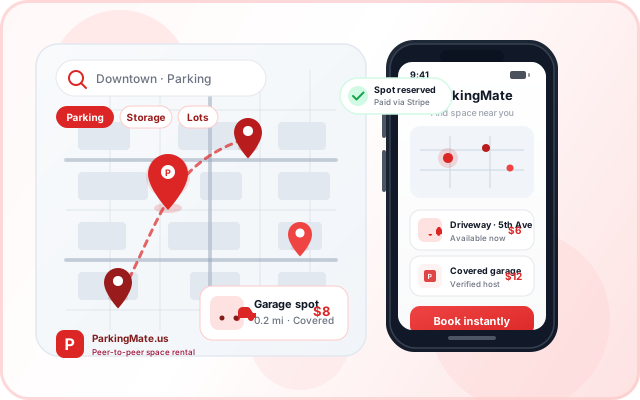
PrimeAppSolution is a Lanham, Maryland software company that designed and developed ParkingMate.us, a full-stack parking space rental marketplace that connects hosts who have unused spaces with renters who need them. The platform operates across 6 space categories: parking, storage, lots, indoor spaces, outdoor spaces, and pools. It serves both individual homeowners listing a single driveway and businesses managing multiple commercial properties.
ParkingMate.us is live in the United States, available on web, iOS, and Android, and processes payments through Stripe. Our web development and mobile app development teams in Lanham delivered the full product. This case study covers what the platform does, the technical decisions behind it, how we built it, and what to expect if you want a similar marketplace.
What Is ParkingMate.us and How Does the Marketplace Work?
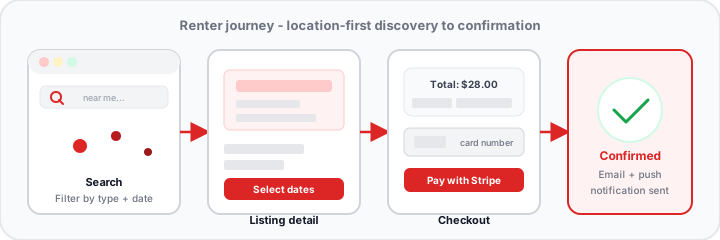
ParkingMate.us applies the same marketplace model that Airbnb uses for homes, but applied to spaces. A host with an empty garage, a spare storage room, a backyard, or a commercial parking lot lists it once and starts receiving bookings. A renter searches near a specific location, filters by space type, and reserves a slot in minutes without calling anyone or signing a contract.
The Two Sides of the ParkingMate.us Marketplace
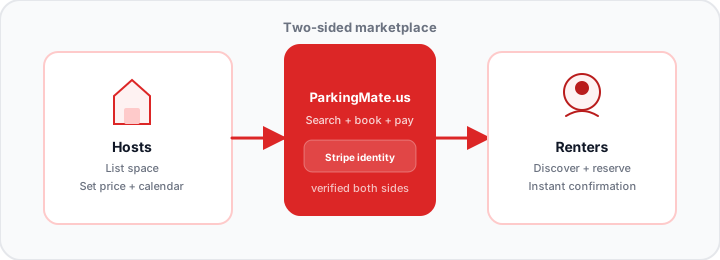
The platform operates a two-sided marketplace with distinct user roles. Hosts create listings, upload photos, set hourly or monthly pricing, and control availability through a dashboard. Renters search, compare listings by price and rating, book instantly, and receive digital confirmation. Stripe handles identity verification for both sides.
The 6 Space Categories ParkingMate.us Covers
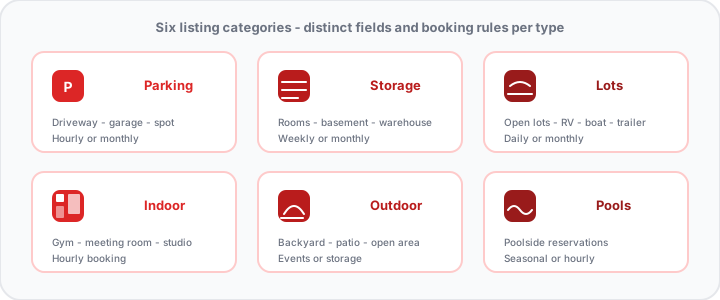
ParkingMate.us covers more than parking. The platform supports 6 distinct space categories, each with its own subcategories and listing types:
- →Parking: Driveways, allocated spots, garages, and monthly rental spaces
- →Storage: Spare rooms, basement storage, and commercial inventory spaces
- →Lots: Open lots for boats, RVs, and trailers
- →Indoor: Game rooms, gyms, meeting rooms, and event spaces
- →Outdoor: Backyards, patios, and open areas for events or storage
- →Pools: Poolside areas listed as reservable spaces
Who Uses ParkingMate.us and What Problems Does It Solve?
For Hosts: Monetizing Unused Space
Hosts use ParkingMate.us to turn idle space into income. A homeowner with an empty driveway lists it for hourly or monthly bookings and earns without any upfront cost. Listing is free. A hotel with excess parking lot capacity lists overflow slots and fills revenue gaps during low-occupancy periods. A gym with unused floor time during off-peak hours lists that space for events or fitness sessions.
Hosts control these variables entirely: price, availability schedule, space description, and cancellation policy. ParkingMate.us does not cap earnings. Hosts keep 100% of the price they set.
For Renters: Affordable, Flexible Space Access
Renters use ParkingMate.us to find spaces that traditional providers do not offer. A daily commuter books a driveway 2 blocks from their office for a fraction of a commercial garage rate. A small business rents short-term storage space month-to-month instead of signing a 12-month self-storage contract. An event organizer books a backyard for a private gathering without the cost of a venue rental.
The platform saves renters up to 50% compared to traditional parking and storage options, with no contracts and instant availability confirmation.
For Businesses: Commercial Space Management at Scale
Business owners get a dedicated portal with enterprise features: a centralized dashboard to manage multiple properties from one login, API integration to embed the ParkingMate.us booking system into their own website, priority listing to boost visibility in search results, and corporate onboarding support for larger property portfolios.
Hotels, restaurants, offices, homeowners, gyms, community centers, storage companies, fleet operators, and event venues. Any owner of underutilized space qualifies as a host on ParkingMate.us.
How Did PrimeAppSolution Build ParkingMate.us?
Phase 1: Discovery and Product Architecture
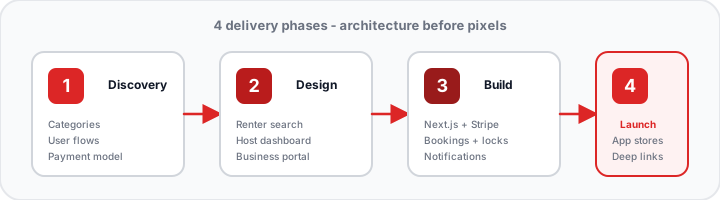
Discovery locked in the core product decisions that shape every marketplace build: which space categories to support at launch, how to structure the host and renter user flows, and which payment model to apply.
PrimeAppSolution mapped out the dual-sided marketplace architecture during this phase. The data models for listings, bookings, users, and transactions were designed before a single screen was wireframed. Marketplaces need that architecture early, because the relationships between hosts, renters, listings, and payments shape every feature that follows.
Phase 2: UI/UX Design
The design phase covered three interface layers: the public-facing search and booking experience for renters, the host listing and dashboard experience, and the business portal for commercial property owners.
The search interface was designed around location-first discovery. Renters enter a location and select a space type, then see results with pricing, ratings, and availability. The host onboarding flow was designed to reduce listing friction. A host can finish a listing in under 5 minutes by uploading photos, setting a price, and defining availability.
Phase 3: Full-Stack Development
ParkingMate.us runs on Next.js, a React-based framework with server-side rendering for fast page loads and strong SEO performance, plus a Node.js API layer and MongoDB for listings, bookings, users, and transactions. That stack is the same foundation we use for custom web development in Lanham. The backend covers listing management, search and filtering, booking and availability locking, Stripe payment processing, and notification delivery.
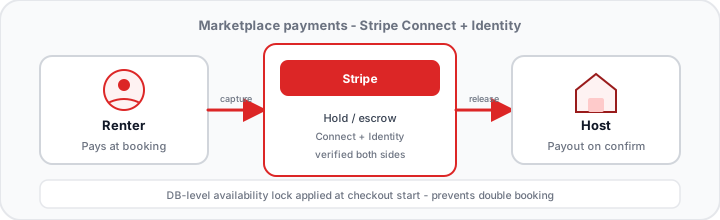
Stripe powers both payment processing and identity verification. Hosts and renters are verified through Stripe's identity system before transacting. The payment flow captures the renter's payment at booking, holds it, and releases it to the host after confirmation. That is a standard marketplace escrow model. RevenueCat manages in-app purchases and subscription entitlements on iOS and Android so billing stays consistent across app stores.
The earnings calculator on the platform is a real-time tool that lets prospective hosts estimate income before listing. A host selects space type, category, subcategory, and size, and the calculator returns a projected earnings range. PrimeAppSolution built this as a conversion tool to reduce host signup drop-off.
Phase 4: Mobile App Development and App Store Submission
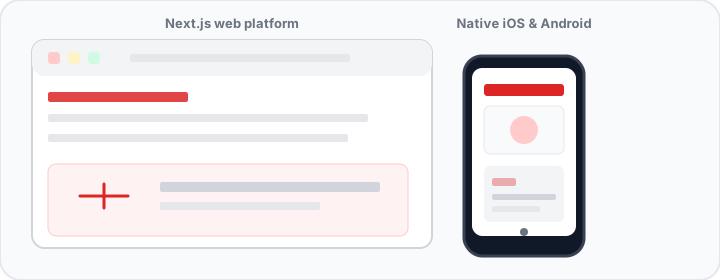
PrimeAppSolution built the ParkingMate mobile app with React Native for both iOS and Android, the same approach we use for mobile app development in Lanham. The app covers the full web platform experience (search, booking, host management, and payment) in a single cross-platform codebase. Both apps passed Apple App Store and Google Play Store review and are live for download.
Mobile marketplace delivery adds a few requirements beyond web: Firebase push notification infrastructure for booking alerts, app store compliance review, and deep link support so notification taps open the correct booking screen inside the app. Cloudflare sits in front of the web and API layer for CDN caching, DDoS protection, and faster global page delivery.
What Are the Core Features of the ParkingMate.us Platform?
| Feature | Who It Serves | What It Does |
|---|---|---|
| Location-Based Search | Renters | Find spaces by type, date, and proximity |
| Instant Booking | Renters | Reserve and pay in under 3 minutes |
| Host Listing Dashboard | Hosts | Manage listings, pricing, and availability |
| Earnings Calculator | Prospective Hosts | Estimate income before listing |
| Business Portal | Commercial Hosts | Multi-property management + API access |
| Stripe Verification | Hosts & Renters | Identity check + secure payment escrow |
| Priority Listing | Business Hosts | Boost visibility in search results |
| iOS & Android App | All Users | Full platform access on mobile devices |
Why Build a Custom Marketplace Instead of Using an Off-the-Shelf Platform?
Generic marketplace SaaS platforms handle standard product or service categories. ParkingMate.us required category-specific logic across 6 space types with different subcategories, different pricing structures (hourly vs. monthly vs. daily), and different booking rules per space type. A generic tool would have forced all 6 categories into a single generic listing template.
| Criteria | Custom Build (PrimeAppSolution) | Generic Marketplace SaaS |
|---|---|---|
| Space Categories | 6 custom types with subcategories | Fixed generic listing structure |
| Pricing Model | Hourly, daily, or monthly, set per category | Single pricing model |
| Branding | 100% custom design and UI | Template-based, limited control |
| Stripe Integration | Custom escrow + identity verification | Basic payment only |
| Earnings Calculator | Custom built as a host conversion tool | Not available |
| API for Businesses | Full API integration option | Not available or locked to paid tier |
| Mobile Apps | React Native iOS + Android, built and submitted | Web-only or basic wrapper apps |
| Data Ownership | Client owns all data | Vendor controls data access |
The earnings calculator is a direct example of a feature a generic SaaS tool cannot deliver. It calculates projected income based on space type, subcategory, and square footage. That logic is specific to ParkingMate.us's category structure. We built it as a host acquisition tool, and it sits on the homepage and the How It Works page so prospective hosts can estimate earnings before they sign up.
What Does It Cost to Build a Parking Space Rental Marketplace?
What Determines the Cost of a Marketplace Build
Several variables drive the total cost of a parking space rental marketplace:
- 1Number of space categories: Each category requires distinct listing fields, subcategory structures, and booking logic. ParkingMate.us covers 6 categories, which is a significant scope driver.
- 2Mobile app platforms: Building for iOS and Android doubles the mobile development scope. Each app requires separate submission and App Store review compliance.
- 3Payment and verification complexity: Stripe identity verification, escrow logic, refund handling, and processing fee architecture each add development scope beyond a basic payment form.
- 4Business portal features: Multi-property management, API integration, and priority listing systems add a full second product layer on top of the consumer marketplace.
- 5Custom tools: Features like the earnings calculator, which require custom data models and calculation logic, add scope proportional to their complexity.
PrimeAppSolution provides written project estimates within 5 business days. Reach out via our contact page or visit primeappsolution.com to discuss your requirements.
What Technical Decisions Did PrimeAppSolution Make for ParkingMate.us?
Technology Stack Used for ParkingMate.us
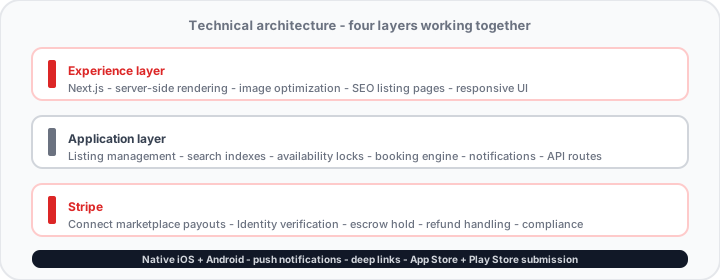
The production stack covers web, mobile, payments, data, and infrastructure:
- →Next.js: SSR listing pages, App Router routes, and image optimization for marketplace SEO
- →React Native: shared iOS and Android codebase with near-native performance
- →Node.js: API routes and marketplace business logic (bookings, availability locks, payouts)
- →MongoDB: flexible document store for listings, users, bookings, and category-specific fields across 6 space types
- →Stripe: Connect marketplace payouts plus Identity verification for hosts and renters
- →RevenueCat: in-app purchases and subscription entitlements on the App Store and Google Play
- →Firebase: push notifications and mobile messaging for booking alerts
- →Cloudflare: CDN, SSL, and edge security in front of the web and API
This is the same stack family we recommend for clients who need custom web development and mobile app development from our Lanham office: one product team, one architecture, both platforms.
Why Next.js for a Marketplace Platform
Next.js fits a marketplace better than a plain client-side React app for a few practical reasons. Server-side rendering means listing pages load with full content visible to search engines, which matters when each listing can rank as its own landing page. API routes keep backend logic in the same codebase, so you need less infrastructure glue. Next.js image optimization also compresses listing photos automatically, which helps page speed on photo-heavy listing pages.
Why React Native, Node.js, and MongoDB
React Native let us ship iOS and Android from one codebase while still meeting App Store quality standards. That was faster than staffing two fully native teams, and it still feels like a real app rather than a thin web wrapper. Node.js keeps the API in the same JavaScript ecosystem as Next.js and React Native, which speeds feature delivery across web and mobile. MongoDB fits marketplace data where listing schemas differ by category. Parking fields are not the same as pool or indoor event fields, so a flexible document store beats forcing every space type into one rigid table.
Why Stripe, RevenueCat, Firebase, and Cloudflare
Stripe covers payment processing and identity verification in one integration. Stripe Connect handles the marketplace payment flow (renter pays, funds are held, then released to the host after confirmation) so we did not need a separate escrow system. Stripe Identity verifies both hosts and renters through document checks, which gave ParkingMate.us verified-host status without building that system ourselves. RevenueCat sits beside Stripe for app-store billing so entitlements stay in sync when a user books or upgrades from mobile. Firebase handles push notifications for booking status changes. Cloudflare protects and speeds up the public web surface, which matters when listing pages also act as SEO landing pages.
Common Technical Challenges in Marketplace Builds
A few technical challenges show up in almost every marketplace build. Here is how we handled them:
- →Double-booking prevention: Availability locks are applied at the database level the moment a booking process starts, preventing 2 renters from reserving the same slot simultaneously.
- →Search performance: Location-based search across multiple space categories requires indexed geospatial queries. Without proper indexing, search response times degrade at scale.
- →Host payout timing: Stripe Connect manages the release of funds to hosts according to the platform's policy, so we did not write custom escrow code.
- →App Store compliance: Both Apple and Google require marketplace apps to meet specific guidelines on payment flows, user verification, and content policies. ParkingMate.us passed both reviews on submission.
Which Businesses Can Build a Platform Like ParkingMate.us?
ParkingMate.us shows that the space rental marketplace model extends beyond accommodation (Airbnb) and vehicles (Turo) to any underutilized physical space. PrimeAppSolution builds marketplace platforms for several business models that share this structure:
- →Parking marketplace: Driveways, garages, and commercial lots listed by private owners and businesses to commuters, event attendees, and residents.
- →Storage rental marketplace: Individuals and businesses listing spare rooms, warehouses, and storage units to renters needing short-term storage without self-storage contracts.
- →Event and venue marketplace: Gyms, community centers, and private property owners listing space by the hour for events, pop-ups, and activities.
- →Fleet parking network: Businesses with large vehicle fleets booking dedicated parking spaces across multiple locations through a centralized management platform.
- →Residential space sharing: HOA communities and residential complexes managing shared space allocation (parking, amenity rooms, outdoor areas) through a booking platform.
Where Is Parking Space Rental Technology Heading?
Dynamic pricing (automatically adjusting space rental rates based on local demand, time of day, and competitor pricing) is the next layer marketplace platforms are adding. A parking spot listed at a flat rate earns less than one priced at $4/hr during peak commute hours and $1.50/hr overnight. Dynamic pricing can raise host earnings while giving renters better off-peak rates.
IoT access integration removes the last physical handoff in space rental: keys or attendants. Hosts with smart locks, garage door controllers, or barrier gates tied to an API can grant renters digital access at booking confirmation. We design platforms so IoT access can be added later as more hosts adopt the hardware.
Hyperlocal marketplace models, where hosts in a single neighborhood or building form a supply cluster, are emerging as a differentiated layer within larger national platforms. A residential building where 20 units list driveways through one branded portal becomes a micro-marketplace that competes directly with commercial parking in that zip code. ParkingMate.us's business portal architecture supports this model today.
Can PrimeAppSolution Build a Similar Marketplace for Your Business?
PrimeAppSolution delivers the full stack of what a marketplace build requires: product architecture, UI/UX design, web development, iOS and Android mobile app development, payment integration, and post-launch support. Every project is scoped on a fixed-price basis. No hourly billing.
Starting a project usually looks like this:
- 1Submit a project inquiry at primeappsolution.com describing your marketplace idea and target audience.
- 2Join a free 30-minute consultation with PrimeAppSolution's project team to discuss scope, timeline, and technical requirements.
- 3Receive a written fixed-price estimate within 5 business days covering all deliverables, milestones, and timeline.
Based in Lanham, Maryland, PrimeAppSolution also delivers mobile app development for businesses that need iOS and Android apps without a full marketplace build, web development for SEO-ready product sites and portals, and chatbot development for businesses automating customer service, lead qualification, or booking workflows with AI.
Build Your Marketplace with PrimeAppSolution
Web Development, Mobile App Development, Chatbot Development
Get a Free Consultation →Fixed-price projects. App Store submission included. Post-launch support